I agree that doctors certainly should “engage” with this issue…and…of course I strongly disagree with the BMJ’s position in favor of physician assisted suicide (PAS).
There is much more to say, though for today I am going to focus on three points: 1) languaging, 2) the idea of organization “neutrality” on this issue, and 3) physician engagement on this issue.
First, languaging around the issue of PAS is important and should not be overlooked. Names matter and, specifically, the specificity of naming matters. Diseases, treatments, etc. in medicine tend to become more exact and accurate over time. This is to help distinguish between one and the next in meaningful ways. The push to move from terms like “assisted suicide” to “assisted death/dying” suggests, charitability, that those in favor of the latter see no difference between someone dying of their disease vs someone dying because of a purposeful lethal ingestion prescribed by a doctor.
Please read that again…people on the pro-PAS side of the argument, at best, see no difference between you dying of cancer and a doctor prescribing you a lethal overdose.
If you believe there is an important moral difference between these then please, please speak up next time you see this in writing or hear it in conversation. Kind, charitable questions can generally help clarify whether the other person understands this essential difference. At the very least we should be clear about what we’re discussing. If you’d like to let the BMJ know what you think, you can contact them here.
Second, Dr. Godlee states both, “The BMJ’s position is that terminally ill people should be able to choose an assisted death…” AND “…the journal has called on professional organisations to adopt a neutral stance on the grounds that a decision to legalise assisted dying is for society and parliament to make.” Just so we’re clear, it’s ok for the BMJ to be in favor of PAS AND it is improper for other organizations to take the opposite position. Gotcha. (Hopefully) No further comment needed on this point.
Third, “Engagement of doctors in recent polls has been limited, with only 20% of physicians, 19% of BMA members, and 13% of GPs responding.” I hope this makes it clear that any polls that might be out there woefully under-, and likely mis-represent, the true opinion of physicians.
This debate is far from over and we are continuing to work with our colleagues and friends across New York State to keep our patients, friends, family, ourselves, and indeed our very profession safe from the scourge of physician assisted suicide!
-Tom Carroll, President – FLG
The BMJ also published a short response by Dr. Carroll to their article here.
The ironically- (and sadly-) named pro-suicide group “Compassion and Choices” is focusing their efforts on passing Physician Assisted Suicide legislation in a number of states, including New York. They will not rest, and so we must not either!
One great organization that will help keep you abreast of developments in the are is Patients Rights Action Fund. Check them out and consider donating.
Remember, those in favor of assisted suicide are tireless and committed to nothing short of open and free access to death on demand. In their own words…
Compassion and Choices Fall Magazine
We are committed to continuing and expanding these efforts. How will COVID-19 impact our ability to authorize medical aid in dying in more states in 2021? Increased competition from issues emerging as a result of COVID-19 and greater awareness of racial inequities will make it more challenging to get any law passed in the near term. However, the unfortunate reality is that large numbers of people have and continue to suffer lonely, isolated deaths. We have seen time and time again that when people experience firsthand the inhumanity of suffering at life’s end, our support solidifies, intensifies and grows.
This reality, along with the momentum we had coming into COVID-19 and a combined total of 50 years of experience successfully implementing medical aid in dying in 10 jurisdictions, leaves me feeling optimistic for the future. We can anticipate authorizing an average of one state per year, putting us on track to realize our strategic goal of ensuring that 50% of the population lives in a state where medical aid in dying is authorized and accessible by 2028. What states look the most promising for advancing medical aid in dying? Massachusetts lawmakers, for the first time ever, advanced their medical aid-in-dying legislation during COVID-19, voting it out of the Joint Committee on Health Care Financing. We are hopeful the state will authorize medical aid in dying in the near term. In terms of the rest of the country, I will be able to answer this question with more certainty on November 3, just after the election. I anticipate lawmakers sponsoring bills in approximately 20 states where we are organizing and working alongside coalitions to move legislation forward. The political climate and grassroots support are increasingly promising in nine of those states — Connecticut, Delaware, Illinois, Maryland, Minnesota, New Mexico, New York, Nevada and Virginia.
Last year, Oregon passed legislation to improve the existing bill. Do you anticipate other states following suit? Absolutely. We have conclusive data that the existing law is unnecessarily burdensome, and we will work with lawmakers in some states to begin to address this reality. Fundamental improvements include 1) the elimination of or ability for doctors to waive the waiting period for patients actively dying; 2) the inclusion of nurse practitioners and/or physician assistants as allowable practitioners; 3) a requirement that providers disclose their medical aid-in-dying policies, allowing patients to make informed decisions about where to access the care they want.
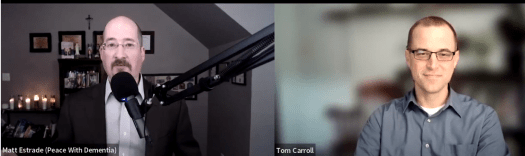
I am honored, and humbled, that Matt Estrade asked me to join him recently on his Peace with Dementia Rosary Podcast! I enjoyed our conversation and I think we covered some important topics around palliative care, advance care planning, MOLST/POLST forms and more!
I also enjoyed praying the Rosary with him. What a nice model for a Catholic Podcast!
You can see the video of our conversation here, and if you’re on the go you can also check out the audio-only version on Apple Podcasts here.
I think it’s fair to say that we who take care of patients at the end of their lives have seen the “will to live” (or loss thereof) drastically affect the timing of a person’s death.
This review suggests the field remains in the early stages in terms of data quality. Definitely will be interesting to keep an eye on future studies.