PAS/MAiD – So-Call Guardrails

Our Governor has provided a list of so-called Guardrails that she says are going to protect New Yorkers. Her public relations office tells us these will, “ensure that no patient was coerced into choosing medical aid in dying and that no health care professional or religiously affiliated health facility would be forced to offer medical aid in dying.”

Here is the list:

  • A mandatory waiting period of 5 days between when a prescription is written and filled.
  • An oral request by the patient for medical aid in dying must be recorded by video or audio.
  • A mandatory mental health evaluation of the patient seeking medical aid in dying by a psychologist or psychiatrist.
  • A prohibition against anyone who may benefit financially from the death of a patient from being eligible to serve as a witness to the oral request or an interpreter for the patient.
  • Limiting the availability of medical aid in dying to New York residents.
  • Requiring that the initial evaluation of a patient by a physician be in person.
  • Allowing religiously-oriented home hospice providers to opt out of offering medical aid in dying.
  • Ensuring that a violation of the law is defined as professional misconduct under the Education Law.
  • Extending the effective date of the bill to six months after signing to allow the Department of Health to put into place regulations required to implement the law while also ensuring that health care facilities can properly prepare and train staff for compliance.

A few things to note here:

  1. What is the definition of “home hospice providers”? Is this referring to Hospice programs or individuals working for Hospice?
  2. What is the definition of “religiously-oriented”? What sort of proof will be required and who will be adjudicating this?
  3. How long will it be before these so-called guardrails start to be chipped away? This has happened in essentially every jurisdiction where PAS/MAiD has been legalized. Whether this occurs though legislative action, court decisions, or just lax enforcement of the law, it seems unlikely that this chipping away will not happen here in NY.

Although PAS/MAiD is now the law of the land in NY, please know that the Finger Lakes Guild is committed to supporting our community in the face of this moral atrocity.

The Finger Lakes Guild of the Catholic Medical Association is comprised of a dedicated group of Catholic physicians and healthcare professionals committed to upholding the dignity of every human life. In response to the legalization of Physician-Assisted Suicide in New York State, we publicly affirm that under no circumstances will we participate in or support this practice. Guided by our Catholic faith and traditional, time-tested, medical ethics, we remain steadfast in providing compassionate, life-affirming care, respecting the inherent dignity of every patient entrusted to us.


We invite individuals, healthcare providers, faith communities, and organizations to partner with/contact us as we work to address the profound ethical and practical challenges posed by Governor Hochul’s decision to sign physician-assisted suicide into law. Together, we can ensure ongoing support, education, and compassionate alternatives that protect vulnerable patients and uphold the true purpose of medicine: healing and hope.

St. Luke, Pray for Us!

Dr. Carroll New Editor of the Linacre Quarterly

We are happy to announce that our Guild President is now the Editor-in-Chief of the Linacre Quarterly, the official journal of the Catholic Medical Association. See here for the CMA’s announcement!

If you are a member of the CMA, you are (hopefully!) already receiving the LQ in the mail. If you are not receiving the print version of the LQ, you can request this by contacting the CMA at  info@cathmed.org.

If you are a CMA member, you can also access the LQ online though the Member’s Community.

Journal Club – February 26

We are pleased to announce that the Finger Lakes Guild of the CMA will be hosting Journal Club on February 26, 2026 at St. Bernard’s School of Theology and Ministry (map) from 6:30pm to 8:00pm. Light refreshments will be provided.

We will be discussing a recent article in JAMA Internal Medicine reporting on clinical “nudges” in the ICU. In this case, the “nudges” were meant to remind ICU clinicians to offer a comfort-only approach to patients and their families who had been intubated for at least 48 hours. While on the surface this seems rather harmless, we will discuss practical and moral issues related to such interventions, their goals, and outcomes.

If you are planning to attend, please let us know so we can plan refreshments. However, you are welcome to join us whether or not you are able to RSVP.

We hope to see you there!

New Bishop

It is with joy that we welcome Bishop John Bonnici as Bishop Designate for the Diocese of Rochester. We look forward to working with His Excellency, Bishop Bonnici, and we ask that you join us in praying for him and his new Episcopate.

We also thank Bishop Matano for his tireless leadership these past 12 years. We cannot say enough about the support he has provided to the Guild and the larger Rochester medical community. We will continue to pray for him as he continues to lead our diocese in the coming months.

The Catholic Courier

Press Conference

Assisted Suicide – Please Help!

Two recent emails have prompted this post.

First, the Patients Rights Action Fund alerted us to the unfortunate news that the Illinois State Senate has, but a VERY narrow margin, passed a State-Sanctioned Suicide bill. As this was previously passed by their State House, it now goes to their Governor’s desk.

Second, Dr. Tim Millea from the CMA sent an email reminding us that unless Governor Hochul actively vetos the bill passed last Spring by both houses of the NY State Legislature…it will become law! Believe it or not, it seems that all she has to do is NOTHING and will be stuck (for all intents an purposes) FOREVER with the abomination that State-Sanctioned Suicide!

Please (PLEASE!) take a few moments to contact Governor Hochul and express your desire to see this bill vetoed before it’s too late!

You can contact here via this link.

While the website option is good, even better is a phone call (or two, or three…). You can reach her office at 1-518-474-8390 (office hours: 9:00am to 5:00pm).

Alternatively, you can send an ol’ fashioned (ideally hand-written) note via post to:

The Honorable Kathy Hochul
Governor of New York State
NYS State Capitol Building
Albany, NY 12224

We’re running out time, so please contact the Governor ASAP!
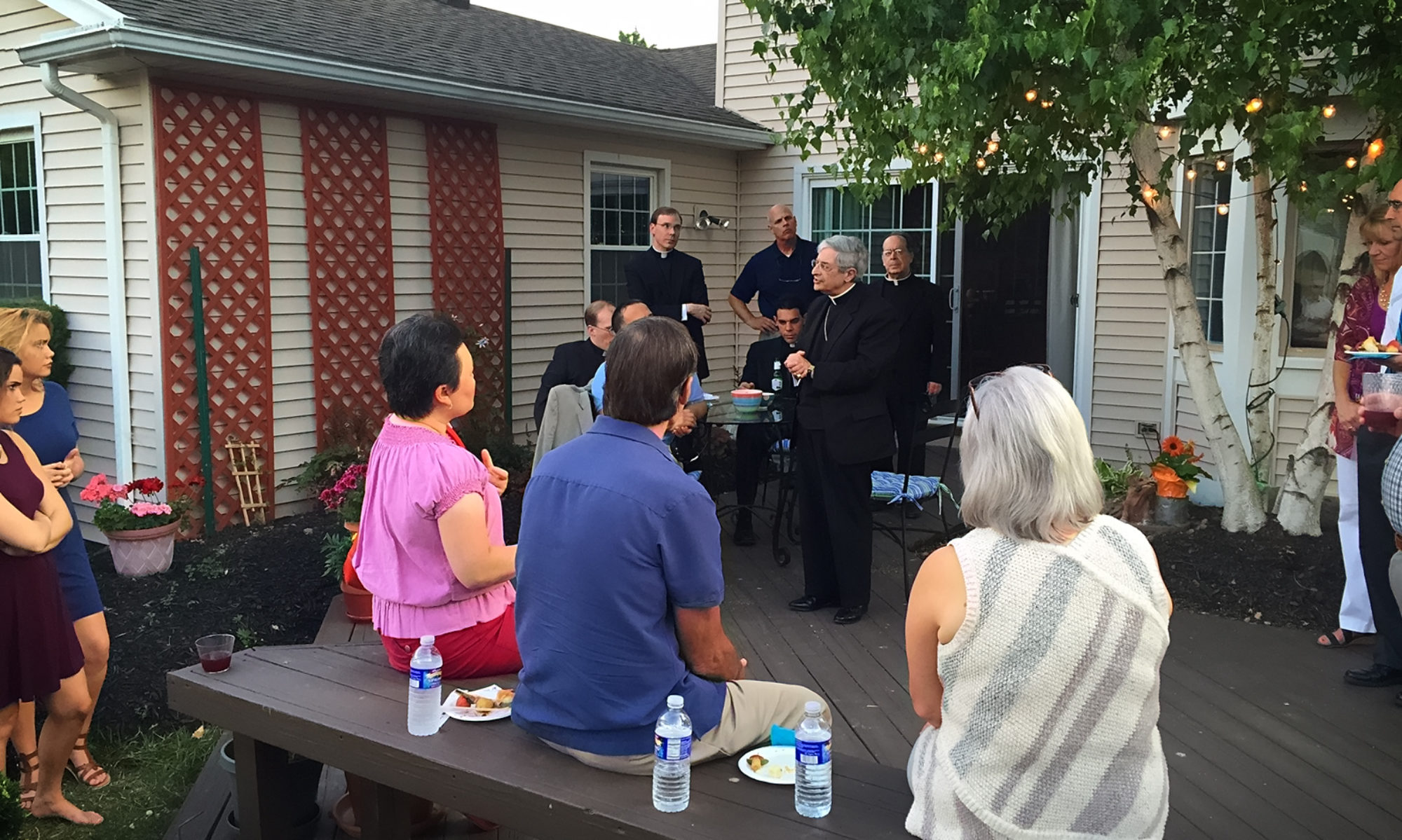
White Mass 2025

Thank you to everyone how attended our annual White Mass on October 12, 2025! We had a wonderful turnout and met new Guild members.

A special Thank you as well to His Excellency, Bishop Matano for celebrating Holy Mass. We are forever thankful for such a generous and loving Pastor of our Diocese!

“Psychedelic Churches”

Some commentary/thoughts on: Psychedelic Churches Need Philosophy of Religion by Dr. Eric Steinhart.

This space previously noted that I published The Psychedelic Renaissance: A Catholic Perspective in 2024, which Dr. Steinhart cited in his paper. Of note, an excellent piece by Dr. Mark Slatter was also cited within the same parentheses as mine.

There’s a lot in this paper by Dr. Steinhart. By way of brief summary, he proposes that “psychedelic churches” need to develop philosophically-robust doctrines in order to obtain legal legitimacy. He lays out six criteria that he thinks need to be satisfied to accomplish this goal. It is with respect to the fifth criterion that he cited my paper and his argument within this section, I think, calls for some comment.

His fifth criterion is that:

...the psychedelic doctrine must use its system of religiously metaphysical beliefs to explain why specifically taking psychedelics is a religious practice.

One objection that Dr. Steinhart addresses is:

Ancient polytheists argued that humans cannot compel the gods, and monotheists later argued that “God can’t be summoned at will” (Carroll 2025; Slatter 2024)

The quoted phrase (“God can’t be summoned at will”) is quoted from my paper, though I cited it from a paper by Dr. Mario Beaugregard and Dr. Vincent Paquette, quoting Carmelite sisters who took part in their EEG and fMRI study of (so-called, but not really!) mystical experiences.

Dr. Steinhart calls his fifth criterion “Psychedelic Theurgy,” in which he seeks to answer the question “…why specifically taking psychedelics is a religious practice,” [emphasis in the original]. He proposes the following:

The argument for the symbolic powers of psychedelics goes like this: Psychedelics reliably induce hallucinations that experientially reveal the existence of divine universes and deities. And psychedelics reliably induce mystical experiences in which the theurgist is united with the Good. The best explanation for these reliabilities is that psychedelics are theurgical symbols of the deities. So, by inference to the best explanation, psychedelics are theurgical symbols of the deities.

With the caveat that I am far from a professional logician, the form of this argument appears to be abductive and so his goal seems to be one of justifying the hypothesis that “psychedelics are theurgical symbols of the deities,” thereby providing a basis to claim that “taking psychedelics is a religious practice.”

The strength of this conclusion rests on the reasonableness of the preceding claims, namely that psychedelics reliably induce both, “hallucinations that experientially reveal the existence of divine universes and deities,” and, “mystical experiences in which the theurgist is united with the Good.”

This reliability claim seems presuppose that ingesting psychedelics are ever, even one time, able to induce these metaphysically real/true, extramental, experiences with “divine universes and deities” and/or “the Good.” In an endnote (#22) Dr. Steinhart references a book by authors Wildman and Stockley and he summaries their view of authentic religious practices or experiences as, “They argue that authentic [religious] practices tend to induce positive personal transformations.” Beyond this, I do not see where Dr. Steinhart provides any evidence to support this proposition.

While it is certainly popular to claim that psychedelics produce positive personal transformations/changes, this is far from obvious. There are multiples lines of evidence that this is not the case, including clear harms documented in scientific studies of psychedelics and anecdotal reports of extremely disturbing experiences:

 I ended up getting fascinated by Rudolf Steiner's ideas about ‘Luciferic’ beings that make alliances with humans and augment our capabilities, although it is a complicated bargain... This is similar to the Djinns of Islamic lore, or the Daimon that Patrick Harpur writes about in The Daimonic Reality and other works. In the Classical world, men would have altars to their Daimons, which represented the spirit of ‘inspiration’. I also had the experience of a voice speaking through me for a week that identified itself as the Mesoamerican creator deity, Quetzalcoatl.

Indeed, in my article I note:

There is a wide range of opinion in the psychedelic literature as to the metaphysical status of ME generally and of PME specifically, ranging from certainly extramental (Davis et al. 2020) to purely intramental.  Perhaps the most prominent proponent of the latter was Dr. Roland Griffiths when he applied the term secular spiritualty to PME (and presumably to ME generally) (Harrison 2023.

I think it is prudent to deal with any given psychedelic mystical experience (PME) as being authentically what the person having the experience perceives it to be, though whether or not it truly is does not particularly matter from my point of view. Rather, I conclude that it is the intent of the psychedelic user that is important and, given the risks that I think are inherent in purposively seeking any mystical experience (relying primarily St. John of the Cross), my conclusion is that any use of psychedelics with the goal of having a PME is illicit.

My view regarding the reality of PME (treat it as real until proven otherwise) is different from Dr. Steinhart’s (psychedelics reliably put us in touch with extramental realities…which are Good) in what I think are important ways. Namely, while I think it is prudent to not discount the possibly of PME being authentically of extramental origin, there is no reason to presume that PME are reliably any such thing.

Dr. Steinhart simply assumes this reliability and, as best I can tell, provides no support for this presumption and there for his argument begs the question. As such, his conclusion, that “…specifically taking psychedelics is a religious practice,” is not supported by his premises and so I think he has failed to fulfil his fifth criterion, and so this does NOT provide support for the “religious legitimacy of a psychedelic doctrine.

– Thomas Carroll, MD, PhD